
World-Class Architecture Hidden In The Nation’s Overlooked Black Cities
Across the United States, cities often defined by economic decline hold extraordinary architecture rivaling Europe’s greatest works. Built during eras of wealth and ambition, these landmarks reflect global-level craftsmanship and design. Many also sit within or near Black communities, intersecting with a cultural legacy of resilience. Here’s a look at some of the nation’s spaces where beauty resides, even when people have stopped noticing.
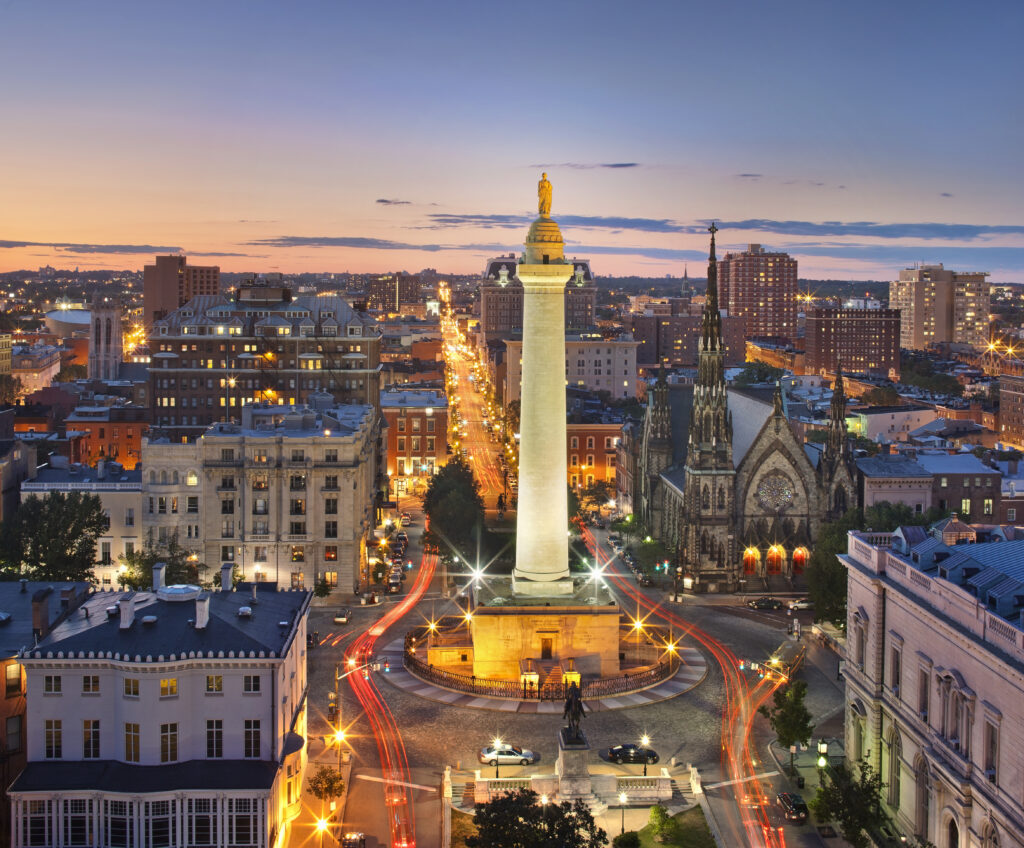
Washington Monument — Baltimore

Did you know that Baltimore, also known as “The Monumental City,” was the nation’s first capital? It was a temporary designation, but the tourist attractions include a marble Washington Monument completed in 1829 — nearly 20 years before the monument in Washington, D.C. As of 2025, Baltimore’s Black-majority accounted for nearly 60 percent of the population, according to WBFF Fox 45.
Playhouse Square — Cleveland
When you think about premier arts districts, you usually think of New York City, not Cleveland. But Cleveland is home to the nation’s second-largest theater district. Playhouse Square in downtown Cleveland features restored historic theaters with elaborate design and dramatic balconies, inspired by European performance halls.
Alabama Theatre — Birmingham, AL
The Alabama Theatre was built to feel like an experience from the moment you walk in. Opened in 1927, it has decorative ceilings, detailed plasterwork and a glowing marquee. Inside, the design draws on European-style theaters, with rich textures and breathtaking architectural detail.
The Cathedral Basilica of the Sacred Heart — Newark, NJ
One of the biggest churches of its kind in the country, with its tall arches, colorful stained glass and detailed stonework, it looks a lot like the famous cathedrals you’d see in Europe. Built over several decades in the early 1900s, the stunning cathedral shows just how much Newark was growing. Even now, it’s hard to miss in the city’s skyline.
Guardian Building — Detroit

With orange brick-patterned tilework and a vaulted ceiling, the Guardian Building is more like a cathedral than a financial building. Completed in 1929, this iconic Detroit landmark serves as a prime example of Art Deco design, featuring custom-made Pewabic tiles and bold, colorful geometry. It was originally constructed to house the Union Trust Company, and today, its preservation stands as a lasting symbol of the city’s architectural history.
Lamar Life Building — Jackson, MS

Jackson, Mississippi is home to Jackson State University, a prominent HBCU, and the Lamar Life Building—the city’s first skyscraper. Completed in 1924, his downtown landmark features Gothic Revival architecture, terra-cotta detailing, and distinctive gargoyle accents. Today, it operates as a mixed-use space with offices and luxury apartments. According to Data USA, Jackson’s Black population is more than six times larger than any other racial or ethnic group.
Peabody Library — Baltimore
Considered one of the world’s most beautiful libraries, the George Peabody Library sits in Baltimore’s historic Mount Vernon neighborhood. Nicknamed Baltimore’s “Cathedral of Books,” the nearly 150-year-old space holds more than 300,000 books, including a first edition of “Moby-Dick,” according to Fox 45. Blending Greek, Roman and French Gothic design, its six-story interior features cast-iron and a massive glass skylight. While the Peabody Institute was once segregated, it now sits inside a diverse neighborhood that is 30 to 40 percent Black.
Cleveland Arcade — Cleveland

The Cleveland Arcade was built in 1890, modeled after Europe’s grand shopping galleries. It was known as “Cleveland’s Crystal Palace,” and the nine-story interior features ironwork, stone and a sweeping glass ceiling. It captures Cleveland’s industrial wealth at its peak and remains one of the country’s most striking architectural spaces.
Lyric Theater — Miami

The Lyric Theater stands as one of the last remaining structures from Miami’s historic Overtown district, once known as the “Harlem of the South.” Its early 20th-century design reflects a time when the neighborhood was a thriving cultural hub, hosting legends like Aretha Franklin and Ray Charles. Though highways later disrupted the community, the building is a preserved link to that era. It shows both architectural continuity and cultural legacy.
Exchange Building — Memphis

The Exchange Building is a 19-story Beaux-Arts skyscraper in downtown Memphis. Finished in 1910, it was once the city’s tallest building. Reminiscent of commercial buildings found in major European cities, it was once home to the Memphis Cotton and Merchants Exchange. Today, the historic landmark is used for both residential and hotel space.
Krueger-Scott Mansion — Newark, NJ
@newarknjblog The Krueger-Scott Mansion has been beautifully restored, bringing it back to its former glory!
This 19th-century mansion has a fascinating history with its previous owners. It was originally owned by Gottfried Krueger, the founder of Newark’s Gottfried Krueger Brewing Company and owner of multiple breweries. It later became the home of Madame Louise Scott, Newark’s pioneering first black female millionaire. Known for her philanthropy and dedication to her community, she left a lasting legacy through her generous contributions. Madame Louise Scott was inducted into the New Jersey Hall of Fame, Class of 2021
#NEWARK #newarknj #newjersey #nj #newjerseyrealestate #architecture #history

The Krueger-Scott Mansion was built to stand apart. Its carved stone exterior and steep rooflines give it a strong presence and a view of the Manhattan skyline. According to The Newarker, the home once belonged to Louise Scott, a Black self-made beauty millionaire from Newark. Its story moves through wealth, decline and restoration.
Fisher Building — Detroit

The Fisher Building blends Art Deco precision with Renaissance-inspired detail. Marble-lined corridors, vaulted ceilings, and hand-painted finishes create a sense of craft you rarely see in a large-scale commercial space. Built during Detroit’s rise as an industrial powerhouse, it now serves as a multi-use space with offices, retail shops and a theater under one roof.