
The Memoir That Reopened a Cold Case: Keffe D’s Words Now Haunt His Murder Trial
After Tupac Shakur was gunned down on the Las Vegas Strip in 1996, conspiracy theories ran rampant over who ordered the hit, and the investigation went cold for decades. That changed in 2019, when Duane “Keffe D” Davis dropped a bombshell tell-all memoir detailing his role in the shooting. Now that his own words are being used against him in his murder trial, which starts Monday (Aug. 10), Davis is walking back his confession.
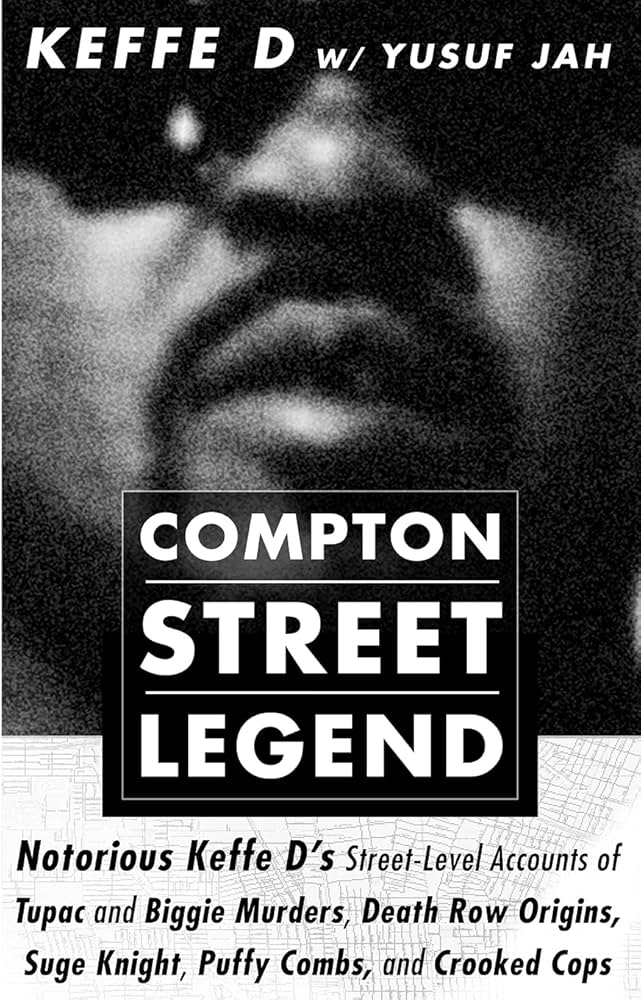
Davis and co-author Yusuf Jah self-published the memoir, “Compton Street Legend,” in 2019, The New York Times reported. The book’s description, called Keffe D “a central figure in both the Tupac Shakur and Biggie murders for the past 20 years,” who will provide “valuable information about two of the biggest ‘unsolved’ crimes in American history. It will serve as the missing piece of the puzzle that Hip-Hop Fans have been waiting for.”
It was that book—riddled with bullet-hole watermarks across its pages that promised to “reveal the street-level code violations and the explosive consequences when the powerful worlds of the streets, entertainment, and corrupt law enforcement collide”—that reopened the cold case, triggered the police raid on Davis’s home, and his ultimate charge of murder with a deadly weapon.

His attorneys, according to The Guardian, tried to keep the memoir from being introduced as evidence, along with remarks he made in an interview with police in 2008 as a witness to the shooting. They were unsuccessful.
Related: 30 Years After Tupac’s Death, a Look at the Events Leading to Keffe D’s Trial
Defense attorney Michael Sanft argued that Davis’s interview with law enforcement was supposed to be confidential and that detectives explicitly told him the interview would not be used against him. “I sang because they promised I would not be prosecuted,” Davis wrote in “Compton Street Legend.” Last month, Judge Carli Kierny ruled that the interview is admissible at his trial, according to NPR
Now, Davis is claiming that not only has he never read the memoir, but that Yusuf Jah inflated the claims just to generate book sales. “I just gave him details of my life. And he went and did his little investigation and wrote the book on his own,” Davis said, per The Guardian.

The defense is now pointing to an interview the book’s co-author, Yusuf Jah, gave police, where he told investigators he had written the book in its entirety based on conversations with Davis, the Times reported. Jah said Davis occasionally recounted information he had heard from others, and admitted that in some parts of the memoir, he had “ad-libbed.”
“Compton Street Legend” stands at the center of the trial, especially since the murder weapon—a .40-caliber Glock pistol—and the white Cadillac the shooter rode in were never found. With the other three passengers now dead, defense attorneys argue the prosecution’s claims are uncorroborated.
“We’re putting way too much credence and value and weight on statements that are made for entertainment purposes only. Not a confession to a priest, not a confession to a police officer, but rather to promote a book, to sell a product,” Michael Sanft, a lawyer for Davis, said at a hearing last month.

“I didn’t write that book,” Davis told 8 News Now in a jailhouse interview.
He also called out the book’s quotes from famous figures as evidence he had nothing to do with it. “I don’t know nothing about no Winston Churchill,” he said. “I just did it for the money.”
Yet prosecutors argue the memoir isn’t a fluke—pointing out that Davis gave the exact same account to police in 2008 and repeated it throughout his media press tour, as reported by the Times.
As jury selection begins in the Las Vegas, Davis has pleaded not guilty. “I’m innocent. I ain’t killed nobody. Never did ever kill nobody,” Davis told ABC News from prison in March 2025. “They don’t have no evidence against me. They can’t even put me in Las Vegas.”
Davis, 63, faces life in prison without parole if convicted.