
‘Our Ancestors Fought So Hard’: Why Thousands Came Back to the Lincoln Memorial
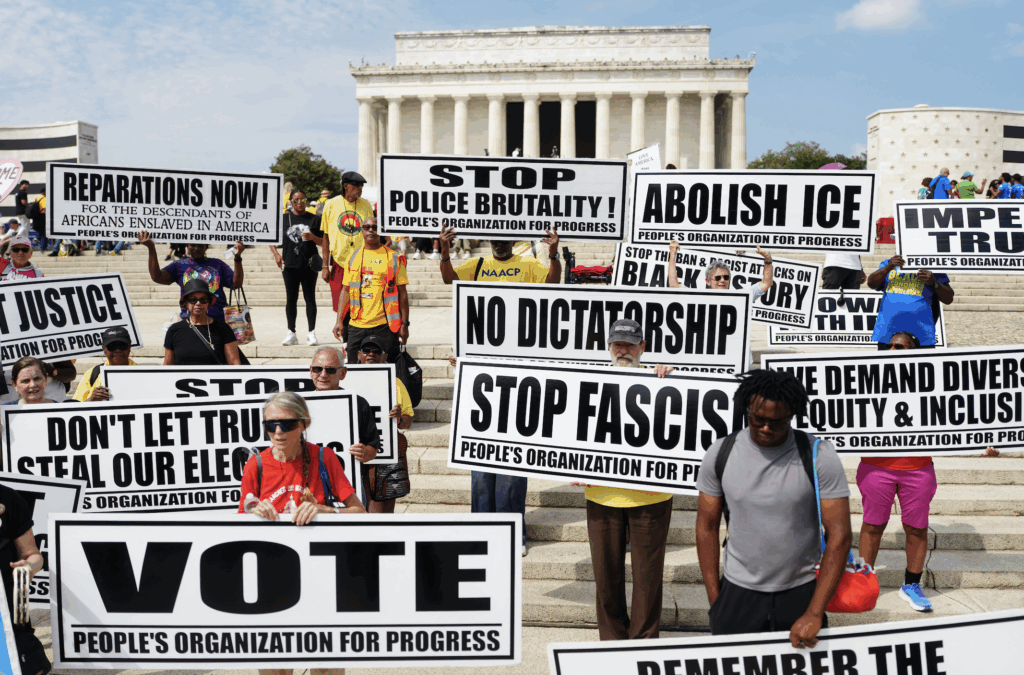
Six decades after Martin Luther King Jr. stood on the Lincoln Memorial and delivered his famous “I Have a Dream” speech, Black Americans returned to the same steps with a familiar message: The fight for voting rights isn’t over.
On Friday (Aug. 28), the National Action Network and the Drum Major Institute — led by Martin Luther King III and Andrea Waters King — called for another march at the historic site, bringing together activists, students, parents, grandparents and everyday people who wanted to make their voices heard and stand up for the political power generations before them fought to secure.
For some attendees, being at the Lincoln Memorial was about experiencing history firsthand.
Abdul, who drove from New Jersey, said this was his first time visiting the site and that being there gave the moment a deeper meaning.
RELATED: Rev. William Barber: Why We Must Reclaim MLK’s Radical Vision
“This moment feels good,” he told The Root. “This is my first time being here, so it feels good knowing that Martin Luther King was here and they’re speaking about Emmett Till and stuff like that. It gives me more knowledge.”
Friday also marked the 71st anniversary of Emmett Till’s murder, adding another layer to an already emotional day.

For Joann Elliott, the march was personal in another way. “My parents came to the march in 1963,” she told us. After traveling to D.C. from New York with her sister, Elliott hopes to continue her family’s connection to the movement.
“I thought it was important to come down here to represent and defend our right to vote.” Elliott said she recognizes the progress made since her parents attended that historic demonstration, but she believes that progress has also faced resistance.
“We’ve made progress, but we’ve been stopped in our progress,” she said. Her message to others was to become more involved at the local level, participate in their communities and encourage young people to vote.
That call resonated with Nya Young, a Howard University student from Kansas City, Missouri, who said organizing and collective action are more important than ever as voting rights face new challenges.
“Our ancestors fought so hard to get to [this] because they know that voting is power. They know democracy is power,” she said. “And that’s something that they don’t get to take away from us.”
Standing at the Lincoln Memorial also reminded Young of the Black men and women who had occupied the same spaces decades before her.
“As a Howard student and as a Black woman in general, we have a responsibility,” she said. “Our responsibility is to stand up for our people. Our responsibility is to go out there to march, to make our voices be heard.”

A man named Black Smoke came to the march with two people he met through TikTok. Their political beliefs and hope for America brought them to D.C. “We’re here, and we’re gonna stay here. We’re gonna keep coming back, no matter how many times [it takes],” he said. “They are not getting rid of us. They are not gonna violate the hard-working folks of America anymore.”
Aisha Cook, a mother and grandmother, came with the next generation in mind. She said too many people have become complacent about voting or believe their individual vote does not matter.
“The more we grow, the more we stay the same,” Cook said. “We forgot how important our vote is. I think a lot of people feel like their vote doesn’t matter. And we saw that in this last election. … People just didn’t come out.”
That’s why Cook said she wanted her children and grandchildren to see her actively participate in a moment that will be documented in history.
“I wanted to make sure that my children and my grandchildren see that I’m not sitting on the sidelines,” she told us. Those gathered at the Lincoln Memorial understood one collective message: history is not simply something to remember. It is something each generation is responsible for continuing and, when necessary, defending.
Cook continued, “It’s important to be here, and it’s important for them to be here so they can carry on the legacy once I’m not here. Because this fight is going to be a lifetime.”