
Tuskegee Just Made 13 New Pilots. The Cockpit Is Still 95% White.
Talk about a full circle moment. Eighty years ago, the Tuskegee Airmen shattered barriers in the skies over Europe. This week, on the same tarmac where that history began, a new class took flight after 13 students secured key FAA flight certifications — with custom leather bomber jackets lined with replica Tuskegee Airmen patches. They enter an industry where Black aviators still account for less than 4.4% of commercial pilots.
Marking the first anniversary of its revived and accredited Aviation Science Program, Tuskegee University celebrated 13 students who earned Federal Aviation Administration (FAA) flight certifications and ratings ranging from private pilot certificates to commercial pilot credentials.
To commemorate the honor, each student received a custom leather bomber jacket adorned with “replica patches representing the famed flying squadrons and units to which the Tuskegee Airmen were assigned, including the 99th, 100th, 301st, and 302nd Fighter Squadrons.”
“The leather bomber jacket you receive today is not simply apparel. It is a symbol – of excellence, preparation and the history you will carry on your shoulders as you master the skies and insist on a place in the aviation industry because you are unequivocally qualified to be there,” Dr. Mark A. Brown, the university’s president and CEO, said.
He told the students that he expects to see them wearing the leather jackets on campus, but they can wait until the scorching Alabama heat subsides.
“Your jacket announces to everyone who sees you that, just as the Tuskegee Airmen did, you represent discipline, commitment, technical mastery, and responsibility,” Brown added. “That is the Tuskegee Way.”
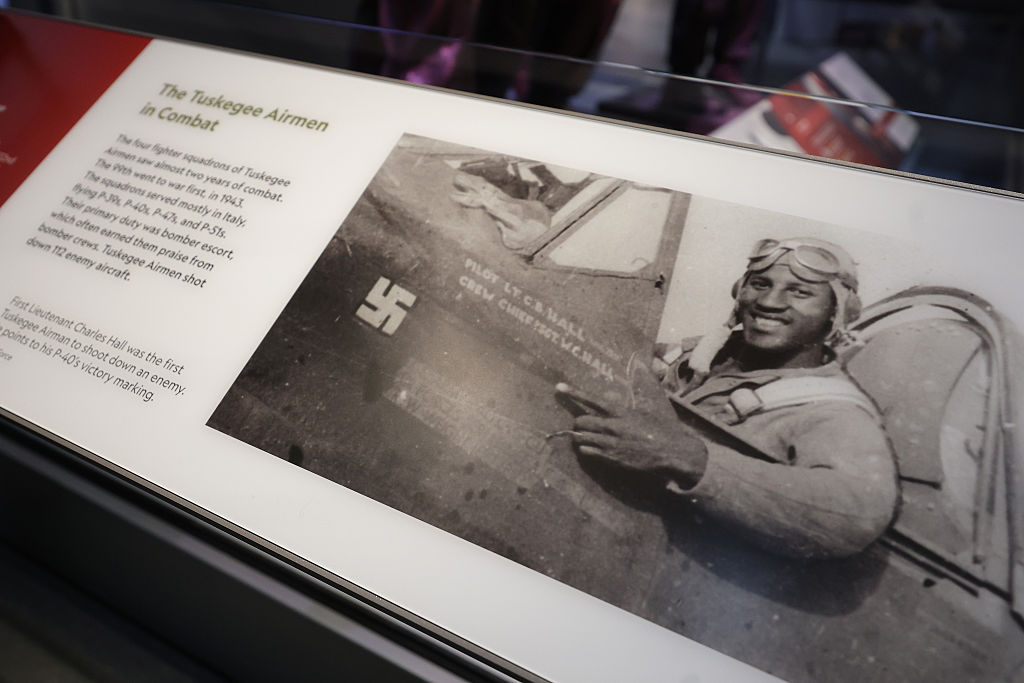
Before equal rights were recognized, the Black men who wore those original patches were thrust into World War II. Known as the “Red Tails” for the crimson paint on the tails of their P-51 Mustangs, the original Tuskegee Airmen flew more than 15,000 combat missions and sorties, helping to pave the way for the desegregation of the U.S. military in 1948.

“When America faced a critical shortage of military aviators during World War II, an experiment was launched on these very grounds. The Tuskegee Airmen not only proved they could fly, they helped secure victory and changed the course of history. Today, you inherit that legacy,” Brown told the future aviation leaders.
Inheriting that legacy carries undeniable weight — especially in an industry where only 4.4% of commercial pilots are Black, and Black women make up less than 0.5%, per Tuskegee University.
Out of more than 150,000 commercial airline pilots in the United States, data from Sisters of the Skies — an organization comprised of professional women of color pilots whose goal is to mentor and professionally develop aspiring aviators — reveals that there are less than 150 Black women pilots.
According to the Federal Aviation Administration, earning a Commercial Pilot License requires 250 total hours of flight time. “However, few, if any, airlines use that amount of flight time as their own minimum standard. They may require 1,000 or 2,000 hours or more,” per the FAA.
For many major flight academies, they require a staggering investment of up to $100,000 to go from zero experience to commercial pilot in the U.S. That number is an immense financial hurdle that disproportionately blocks aspiring Black aviators who face systemic wealth gaps and lack institutional funding.
“You won’t change that 4.4% because you walked through the door,” Brown told the Tuskegee students. “You will change it by turning around and bringing along someone else. Find your replacement, mentor your replacement, be the standard-bearer you have been trained to be.”