
The Promise of ‘Noah’s Arc’ — and the Long Wait for Black Queer Love Stories to Break Through
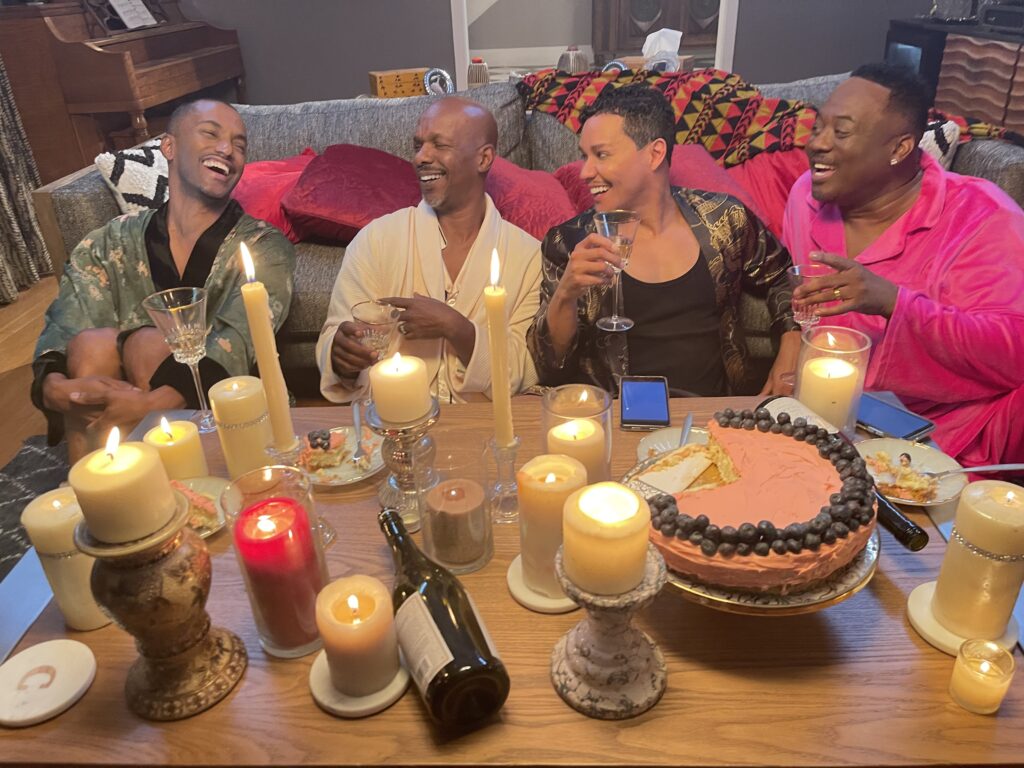
When “Noah’s Arc ” premiered in 2005, it felt like the beginning of a new era. For the first time, an ensemble cast of stylish, complicated Black gay men stood at the center of a television series, unapologetically living, loving, and navigating friendship on screen. The Logo series quickly became a cultural touchstone, spawning movies, reunion specials, and a fiercely loyal fanbase that remains active nearly two decades later.
At the time, many viewers assumed the show would open the floodgates for more Black LGBTQ representation in television and film. Instead, audiences largely found themselves waiting.
Now, more than 20 years later, the runaway popularity of “Heated Rivalry” — a queer romance centered on two white, masculine-presenting men — has reignited an uncomfortable question among many Black LGBTQ viewers: Why does fully centered Black queer love still feel so rare in mainstream entertainment?

The conversation gained new momentum after “Noah’s Arc” star Darryl Stephens suggested he did not believe “Heated Rivalry ” could’ve hit as hard as it did in the U.S. without two white-presenting, masc-presenting main characters.
For Tre’vell Anderson, executive director of the Trans Journalist Association and an author who’s spent years taking Hollywood’s pulse on minority representation, the reaction reflects a much older pattern in Hollywood.
“What we know is that the system that is Hollywood is very used to recycling these unfounded beliefs about the worth of stories from historically excluded communities,” Anderson says. “They’re always surprised when a Black movie does well or a Black show breaks out.”
That same logic, Anderson argues, continues to shape how Black queer stories are perceived inside the industry.
“When the rubber meets the road, what we know from history and experience is that there’s this tired sentiment within the industry that stories centering historically excluded communities are somehow niche,” Anderson says. “That’s another way of saying enough white people might not like it to make it profitable.”

Hollywood has certainly evolved since the early 2000s. GLAAD’s annual “Where We Are on TV” documents representation of LGBTQ characters. The 2024-2025 report shows a significant decrease in Black queer characters in film and television. Of the 489 LGBTQ characters counted across all platforms, 85 (17%) were Black. This is a decline of 10 characters. Series like “POSE,” “P-Valley” and “The Chi” have expanded visibility in meaningful ways. Yet, “Pose” concluded its run in 2021 after the third season; “P-Valley” is on an indefinite hiatus; and “The Chi,” now in its final season, will soon end its run.
But Anderson argues representation is still often partial, conditional, or peripheral.
“Outside of ‘Noah’s Arc,’ the Black gay narratives we see on screen often aren’t centered,” Anderson says. “They’re part of somebody else’s storyline.”
Even “Pose,” widely celebrated for its groundbreaking trans representation, initially framed viewers’ entry into ballroom culture through a white protagonist navigating Manhattan corporate life.
“The storytelling mechanism of using whiteness as the outsider view into a community of color or queer community is not new,” Anderson says, adding that true progress would require far more than temporary diversity initiatives.
“There would need to be an industry-wide legitimate reckoning,” he says. “Not just temporary positions created and ineffective diversity fellowship programs, but efforts that legitimately transfer and reset what power looks like in this industry.”
Still, not everyone believes the conversation is as simple as the absence of another “Noah’s Arc.”
A Fractured Entertainment Landscape
For queer actress and producer Lena Waithe, representation has evolved in more nuanced ways, particularly as queer characters increasingly exist inside broader social worlds rather than exclusively LGBTQ-centered spaces.
“I love when shows show queer people navigating a lot of different types of spaces,” Waithe says.
She points to her work across “Twenties” and “The Chi,” as well as upcoming projects she is developing, as examples of storytelling that reflects the complexity of modern queer life. In her view, many LGBTQ people today move fluidly between queer and non-queer communities in ways television is only beginning to fully capture.
“We live in a world where there are all kinds of people around you,” Waithe says. “Your friend group is your choice, but in a profession or with your family, you may be the only queer person there.”
At the same time, Waithe says difficult questions remain about audience behavior and support.
“If the same show existed with two Black guys at the center, would the same thing be happening?” she asks of “Heated Rivalry.” “That’s really a question I can’t answer.”
She believes conversations about representation cannot stop at what audiences claim they want.
“We can ask for something,” Waithe says. “But the next question that follows is: do we want to show up for a show like this? Or do we only want to highlight a certain kind of Black love?”
That question becomes even more complicated in an entertainment landscape where “mainstream” itself no longer means what it once did. For creator An’darrio Abrams, many conversations about representation are still operating from an outdated television model.
“When I think of mainstream, I think of Paramount+,” Abrams says. “Those are now the new mainstreams.”
Abrams created the independent reality franchise “Chasing Reality,” which later expanded into a series including “Chasing Dallas” and “Chasing Los Angeles.” He believes many Black LGBTQ creators are already producing meaningful work — audiences and media gatekeepers simply are not valuing those spaces equally.
“We are in an age where people are canceling cable services,” Abrams says. “The focus now is to lean into indie films and indie reality shows because honestly, those are the ones that really hit home for people.”
Independent platforms, he argues, often allow Black LGBTQ creators to tell fuller stories without the restrictions of major networks.
“It’s not as restrictive,” Abrams says. “If we were to land a deal on a network, we would have to face restrictions.”
For Patrik-Ian Polk, that independent spirit is nothing new. Long before streaming fractured the entertainment landscape, Polk self-financed “Noah’s Arc” because he believed no traditional network would take the chance.
“The fact that it happened is a miracle,” he says.
Even now, after multiple films, reunion specials, and years of cultural influence, Polk says the struggle to secure institutional support has not disappeared. Following the strong performance of the 2025 “Noah’s Arc: The Movie,” he hoped renewed momentum might finally create space for more Black queer storytelling inside major studios.
Instead, he says, the franchise once again found itself without a clear future.
“We were waiting patiently,” Polk says. “Only to be told essentially they have zero interest in doing any more ‘Noah’s Arc.’ Here we are.”
Still, he has not stopped creating. Polk is currently shopping TRADE, a new series he describes as a Black version of “Heated Rivalry” set in the hip-hop music world.
“I first started working on this idea over 20 years ago, but thought a series about a gay rapper would NEVER get made,” Polk said. “Two decades later, working as a writer and Co-Exec Producer on Katori Hall’s brilliant ‘P-Valley’ changed my mind and inspired me to pull ‘TRADE’ off the shelf and give it new life.”
He remains cautiously hopeful that the right executive or network will eventually take the leap.
“It’s about connecting with the one who gets it, and it just opens up,” he says. “So far, the industry response has been positive. There’s serious interest from several networks and streamers, and I’m genuinely hopeful this show can happen.”
Without the success of “Heated Rivalry,” Polk said he doesn’t believe there would be an appetite for his new project, and now there is. Jacob Tierney, Rachel Reid, Connor Storrie, and Hudson Williams, wherever y’all are—thank you! And thank God for “Heated Rivalry!”
But Polk also says Black LGBTQ creators can no longer afford to place all their hopes in Hollywood validation alone.
“I’m not saying give up on Hollywood,” he says. “But it can’t be the only focus. I can’t keep putting all my eggs in the Hollywood basket because I’ll just keep sitting around with spoiled eggs and no omelets.”