
In 2026, The Fight For Black Representation Demands ‘Good Trouble’
At nearly every turn over the last year, it has felt like the rights of Black Americans are being pulled back, challenged or rewritten in real time. Voting laws are changing. Redistricting fights are reshaping political power. And across the country, Black voters are once again being forced to pay close attention to who gets represented and who gets left out.
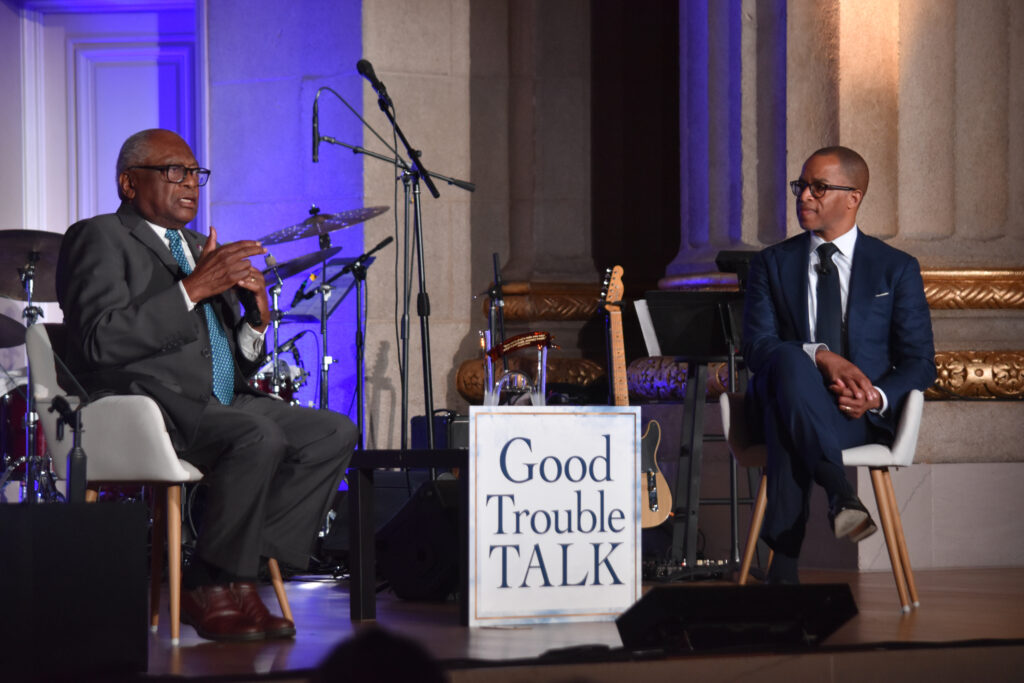
That was the backdrop this week at the Good Trouble Gala in Washington, D.C., where Rep. Jim Clyburn of South Carolina received the John Lewis Award and Maryland First Lady Dawn Moore received the Lillian Lewis Award.
The late-Rep. John Lewis (D-Georgia) used the phrase “good trouble” to describe the kind of necessary disruption that challenges injustice, demands accountability and pushes the country closer to its promises.
So The Root asked lawmakers and advocates to define what “Good Trouble” means to them in 2026 and how people can practice it.
For John-Miles Lewis, the son of the late congressman, the answer was simple.
“Right now it means a lot more than it would have meant a few years back,” Lewis said. “Now is that time for that necessary trouble.”
He said his father “worked too hard” for people to come this far, only to be pushed backward. “It feels almost like Jim Crow’s coming up on us again.”

That urgency echoed throughout the night.
Maryland’s First Lady Dawn Moore pointed to her state’s recent voting rights efforts, saying, “Good Trouble is exactly what we’re doing in Maryland, and it’s protecting our people.” Moore added that “everybody has the right to vote” and said the state must ensure “fair and free and safe elections.”
On stage, Sen. Jon Ossoff (D-Georgia) warned that attacks on voting rights and representation are not abstract. He said Black elected officials are being targeted “not by defeating them at the polls, but by manipulating maps to dilute minority power.”
Rep. Jim Clyburn (D-South Carolina), who accepted the John Lewis Award, used his moment to remind the room that the fight for democracy is not just about what the other side does. It is also about whether our communities show up when it matters most.
Pointing to past midterm elections, Clyburn warned that political power can shift dramatically when voters stay home.
“If we turn out the vote, we’re gonna win big,” Clyburn said. “If we don’t turn out the vote, we’re gonna lose big time and for a long time.”