
How Fannie Lou Hamer Outsmarted a U.S. President
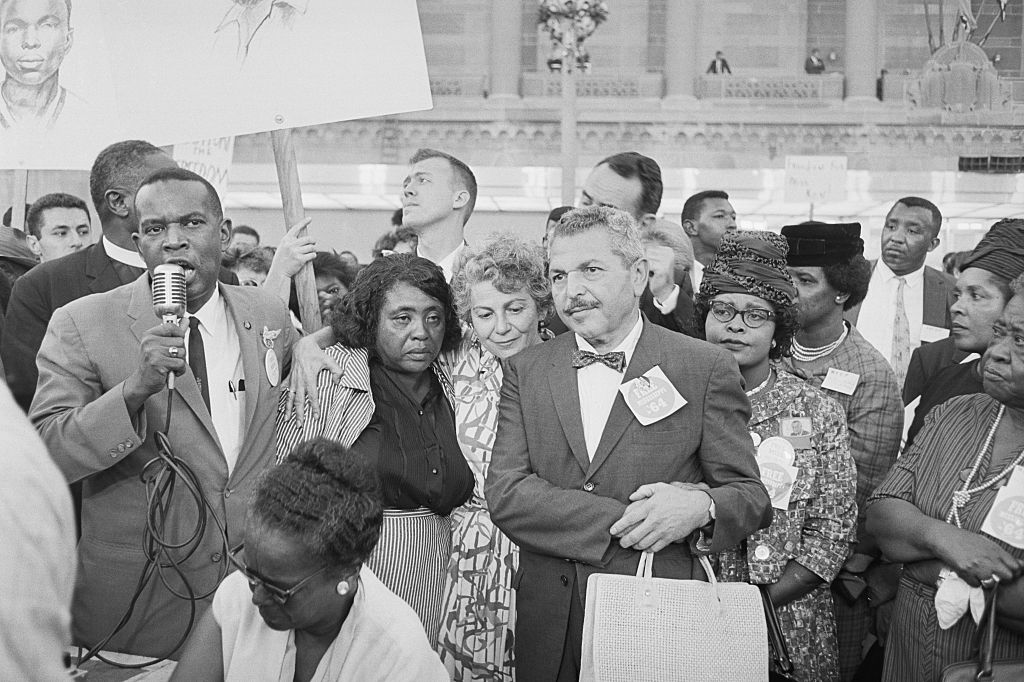
President Lyndon B. Johnson thought he could outsmart the networks by calling an abrupt press conference as civil rights activist Fannie Lou Hamer testified before the Credentials Committee about being fired, evicted, and beaten in a Mississippi jail for trying to vote. Ahead of the midterms and what would have been her 109th birthday, The Root looks back at how the attempt to silence her backfired into one of political history’s most explosive victories.
By 1964, Black activists in Mississippi had hit a breaking point. Without the ballot, policy remained locked in place, leaving them defenseless against systemic oppression, the New York Historical reported. That breaking point found its voice on August 22, 1964, when Fannie Lou Hamer risked her life and stepped up to the microphone in Atlantic City, telling the nation a raw truth about the terror Black Mississippians faced just trying to cast a ballot.
With a voice steady, a piercing demeanor, and gripping testimony, Hamer described how she was met in Indianola by white policemen, who arrested the bus driver for driving “a bus the wrong color.” She recalled how “the plantation owner was angry because I had gone down to try to register” and demanded her to leave that very night because “we are not ready for that in Mississippi.” What followed was immediate, terrifying retaliation.
Sixteen bullets were fired into “the home of Mr. and Mrs. Robert Tucker for me,” Hamer testified, as she had been staying with the Tuckers because she was evicted from the plantation where she worked for trying to register to vote. But her determination was just as unyielding as the attacks against her.
On June 9, 1963, Hamer—who grew up picking cotton and cutting corn—returned to Mississippi for a voter registration event with a group when the bus stopped for a break in Winona. She and everyone on the bus was arrested, and she was taken to the county jail. Hamer remembered a police officer yelling “horrible things” and officers threatening: “We are going to make you wish you was dead.”
RELATED: In the Wake of Black Exhaustion, the South is Still Fighting for Black Political Power
White men in the jail made a Black man force her onto a bunk bed face down, while another Black man beat her with a weapon until he was too tired, Hamer testified. “The second Negro began to beat and I began to work my feet, and the State Highway Patrolman ordered the first Negro who had beat me to sit on my feet—to keep me from working my feet. I began to scream and one white man got up and began to beat me in my head and tell me to hush,” Hamer said. She would later say that the beating had made her “as hard as metal,” per the Smithsonian.

All while Hamer was testifying of the unimaginable violence that occurred over four days, a panicking President Lyndon B. Johnson made a desperate bid to shut down the broadcast, PBS reported. Terrified that the explosive testimony would alienate white Southern voters and threaten his re-election campaign, LBJ hastily called an emergency, unscheduled White House press conference to force major TV networks to cut away from the convention floor.
LBJ tried—and failed—to frame the impromptu press conference to mark the nine-month anniversary of the assassination of President John F. Kennedy and the shooting of Governor John Connally. However, the maneuver backfired. The viewing public was confused. And their bewilderment led to a backlash he never saw coming.
Realizing what the White House was attempting to do, Hamer’s powerful “Is this America?” speech was later replayed by major news network in full during evening broadcasts. That move exposed her message to an even larger audience than would have otherwise seen it. But Hamer was just getting started.

In 1964, with the support of the Mississippi Freedom Democratic Party (MFDP), Hamer ran for Congress against Jamie Whitten, a powerful white incumbent who had been elected to office twelve times and faced virtually no real political competition due to total Black disenfranchisement.
A reporter observed: “Whatever she is talking about soon becomes an impassioned plea for a change in the system that exploits the Delta Negroes. ‘All my life I’ve been sick and tired,’ she shakes her head. ‘Now I’m sick and tired of being sick and tired.’”
The Democratic Party refused to allow her on the official ballot, and she lost the election even after 60,000 Black voters wrote in her name. But, she did gain something far more enduring: a legacy that turned her horrifying struggle into an unstoppable national movement.
The historic passage of the Voting Rights Act of 1965—a landmark statute that prohibits racial discrimination in voting—was signed into law one year later during the height of the civil rights movement, alongside the 1965 Civil Rights Act, which banned local laws like the literacy test that had prevented Hamer from exercising her right to vote.

“All of this is on account of we want to register, to become first-class citizens,” Hamer said. “And if the Freedom Democratic Party is not seated now, I question America. Is this America, the land of the free and the home of the brave, where we have to sleep with our telephones off the hooks because our lives be threatened daily, because we want to live as decent human beings, in America?”